
by Socialist party member in unite
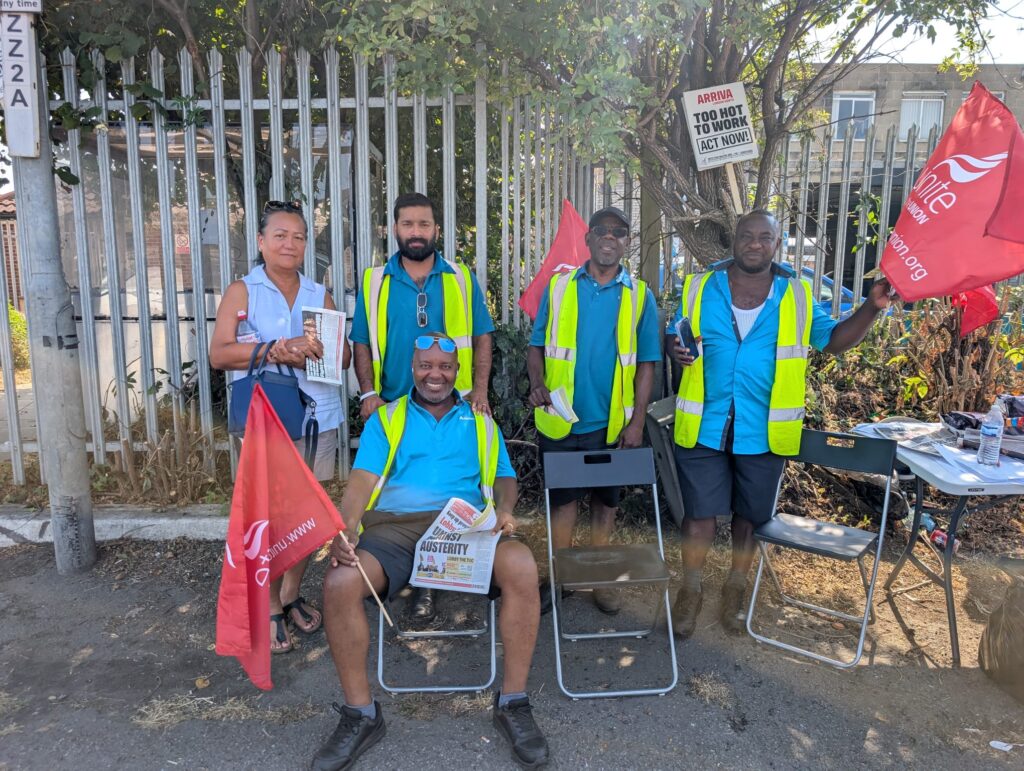
Unite members at Arriva London North have won a huge victory following strike action to protest the appalling temperatures on buses.
Unite national lead officer Onay Kasab said: “This is an excellent win for our members, who stood together on picket lines to fight for and win an agreement that means that drivers are not simply expected to sweat it out. Unite members have once again shown the value of collective union action.”
Hot working temperatures are not a new problem. But this is the first time that bus workers in London have taken strike action and won a groundbreaking agreement.
It is also an example of how trade union action, through strike action, can fight the impact of climate change in the workplace. This win provides the platform for a campaign for a wider debate about the role of unions and climate change, while at the same time making a huge difference to workers.
The key parts of the deal are that drivers will be able to return vehicles after 35 minutes of driving, should the air-cooling system or air-conditioning not be working. At present, drivers are just expected to drive on. Should drivers feel unable to return the vehicle to the depot, they can park up after 35 minutes.
Defective buses will not be put back out on routes until repaired. At present, when they are returned, buses have simply been allocated to another driver.
The agreement includes a written commitment for all buses to be fitted with air-conditioning by May 2027.
The 35 minutes only applies to diesel/hybrid buses. Electric vehicles have been accepted as only needing a few minutes. Importantly, the agreement also covers cold buses – at present drivers must do an hour. The agreement will mean auditing and repairs carried out through the year.
Drivers have made clear that they have no trust in the employer. Further, the target date of May 2027 for the retro-fitting is a tight one. For both reasons, the union is not cancelling the strike mandate.
While the strike dates already given have been lifted following the members agreeing the deal, the strike mandate remains for another eleven months, so that should the employer renege on the agreement, then ten days’ notice can be given for further strikes (rather than a reballot).
The task now will be to use this brilliant win by calling an industrial combine of all Unite bus reps, to take up the issues of temperatures and the wider driver-fatigue issues. And continue to campaign for buses to be brought back into public ownership.
But in the immediate, this must be recognised as a significant win and one that would not have been achieved without strike action.
The strike action by Arriva drivers, and the threat that this could spread across London, has rattled the bus bosses across the city. On Wednesday 9 September, Unite announced that it has “secured agreement for major improvements to working conditions for London’s bus drivers. Following Unite’s campaigning work around hot weather working, Transport for London and the capital’s bus operators have now committed to fitting all London bus driver cabs with air conditioning by May 2027.”
Workers action against hot London buses – United action can win
🕒 2nd September 2026
After two days of strike action at eight bus garages, bus drivers and their union Unite forced management at Arriva London North to the table. The first offer was rejected by drivers on a vote, and strikes continued in the last week of August.
The Socialist Party’s leaflet says: “Sharon Graham, the newly re-elected general secretary of Unite, is backing the strike. This is great — and one concrete way she could help the strikes is by helping them spread across the city. The best way to get a resolution to the issue of overheated cabs is by all-London action. Sharon Graham should organise a combine of Unite bus reps from all the different garages to discuss how we can make sure every garage is part of the action.”
The Socialist Party leaflet demanded that London buses are taken back into public ownership, and put forward what councils that say they are anti-austerity — such as the newly-elected Green councils in East London — should do to put the pressure on Sadiq Khan to throw out the private bus operators.
- See socialistparty.org.uk for the full leaflet. As we go to press, further strike days are planned.
A constant stream of drivers were reporting to the picket line in the heat of the afternoon sun at Stamford Hill in Hackney.
One picket described how occasionally they have to drive a bus that belches out large quantities of noxious gas that not only invades the cab, but can envelope the whole bus. As if on cue, clouds of acrid smoke emanated from a garage smoke stack, that polluted the whole of the street for 20 yards in each direction, including part of the school opposite.
The pickets also said they felt sorry for the public who are forced to endure the sweltering hot temperatures of nothing more than a greenhouse on wheels. Although this strike is primarily about hot cabs, in the winter months the opposite problem occurs, of drivers losing the feeling in their legs due to no heating.
The strike seemed very solid at Stamford Hill, and they want cast-iron guarantees on fully functioning air-conditioning that cannot be reneged on.
Brian Debus
A majority of drivers at Barking had voted to accept the offer, including several on the picket line. The pickets were clear that a union’s strength comes from unity, so as a majority across the Arriva garages had voted to keep fighting, that is what they’d do. A couple of them had been in two minds, but once they saw the picket line they knew they couldn’t cross it and joined it instead.
Alongside the issues in this strike, one driver explained how a fight was also needed on pay. “My wages have gone up from £10.40 to £18 over 20 years. In real terms that is a pay cut. With three kids I can’t afford to live on this”.
Hannah Sell
A just-qualified new driver joined the union and the strike, there and then on the picket line at Southbury in Enfield. At this garage, most drivers had voted to accept the offer, though they didn’t trust management. Still, the workers wanted to stand with their colleagues.
Ian Pattison
At Palmers Green in Enfield, I asked drivers what they thought the cost of installing air-conditioning in the cabs would be. I learned that we are not dealing with a small local bus company without recourse to significant funds. One striker told me that when he visits other countries in Europe, he sees Arriva buses.
According to the Arriva Linkedin page: “Arriva is the leading passenger transport operator in Europe, employing around 36,200 people and delivering 1.5 billion passenger journeys each year, with businesses across 11 European countries.”
Arriva was bought by I Squared Capital for 1.6 billion euros in October 2023 – a company registered in the Cayman Islands. Open the books – show the workers where the money is!
Sarah Sachs Eldridge
One rep said: “If it’s to monitor drivers and keep on at us, they sort out the technology straight away. But if it’s to make our working conditions better, we have to wait forever.”
London bus workers take action for safety in the heatwave
🕒 19th August 2026
Over 1,500 Arriva North London bus drivers at eight garages went on strike on 14 August over “roasting” conditions in the heatwave.
Onay Kasab, Unite national lead officer, said: “Unite members at Arriva have shown that the time for talking is over. It’s time for action. It is no use telling a worker, who works within a bullying management culture, that they have the right to a safe workplace in law — the point is how we implement it, how we make sure it happens. And that’s what these workers are showing. We stand together, we act collectively and we win safe working conditions.”
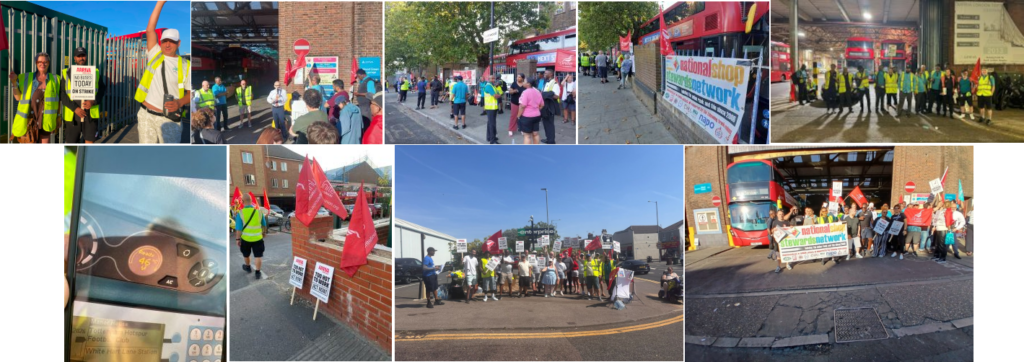
Socialist Party members visited strikers at every garage. At every picket line, we were shown photos of cab thermometers: 38, 40, 42, 45, even 48 degrees!
At Grays, Essex, drivers talking to Ciarán O’Donoghue expressed serious anxiety about safety and what would happen if they were to crash because they passed out due to heatstroke. They were concerned for their passengers and pedestrians in such an event, but also themselves — as they would be held liable! “One driver was telling me he got through 2.5 litres of water and a litre of Lucozade on his shift yesterday. They wished the drivers from other companies in other parts of London, not just Arriva, were also out on strike — the strike would be even more effective at forcing concessions.”
Amnon Cohen reports from Wood Green that “one driver told me that they do have air-conditioning in the buses as they are quite modern vehicles. But they are not working. The belts are disconnected.” At Tottenham, pickets told Sam Smithson the same thing: “Many of them think it is done on purpose to save fuel. Lots of people were talking about how more needs to be done on pay and conditions generally”.
At Southbury, in Enfield, Paula Mitchell was told: “Most of our buses are old. They don’t have air-conditioning, they just have blowers. We sit surrounded by plastic and are drenched in sweat. We’re allowed a ten-minute break if it gets too hot, then we have to get back in the same sweltering cab again. I had to go home early because I nearly fainted, I was so dizzy. Then in the winter, they don’t have heaters either!”
One picket said: “This isn’t about pay, but we do need a pay rise as well. We’ve got a new prime minister but where’s the money? He’s talking about social care. I worked in social care for years, and they are very low paid. We all need a pay rise.”
“Pickets at Barking were feeling like they were finally getting the action they needed,” reports James Ivens. “They estimated the action was about 85% solid across the employer. Told me of incidents including a driver passing out from heat and being taken to hospital, and another colliding with a lamppost just the day before the strike, with photos showing him sweating and looking faint.
“Everyone I spoke to was saying the buses have to go back into public hands, and that the Arriva strike should be a step towards action across the franchises in London, on the litany of bus issues.”
Other workers, seeing the strike, were heard saying: “If they can strike over hot buses, why not hot schools and hot hospitals.”
Further strikes are scheduled for: 18-21 and 25-28 August; 4-5, 7-8, 18-19 and 21-22 September; 2-3, 5-6, 16-17 and 19-20 October
No more roasting, no more waiting: London bus workers ready to shut the capital down
by Moe Manir, London bus driver, Unite member
At around 4am, 14 August, over 1,500 Arriva North London bus workers walked out at eight garages — Barking, Edmonton, Enfield, Grays, Palmers Green, Stamford Hill, Tottenham and Wood Green — the first of 26 strike days running to October, on a 96% strike vote. The biggest London bus dispute in nine years.
Cabs are hitting 40°C and more, while “air cooling” units just push hot air round in circles, cutting the temperature by two or three degrees at best. Drivers are collapsing, sitting in seats soaked with the last driver’s sweat, and still getting punished for it: “I’m hearing colleagues say they try to threaten sanctions… threatening docked pay, or being put up for disciplinary for refusing to drive buses that are too hot to drive,” one Arriva driver told ITV News on the first strike day.
On the picket line at Wood Green, Unite national lead officer Onay Kasab gave drivers the message they needed to hear. “There has been enough talk and enough motions from the Greater London Assembly,” he said. “You are doing what is necessary, taking collective action, standing together. That is what trade unionism does.”
He told drivers this is a chance to finally deal with a problem that has been around for decades, and that the point of this fight is to give every bus driver, not just in London but right across the UK, the confidence to take the same action. Asked whether the fault lay with government, the Greater London Assembly (GLA) or the bus companies, he got the loudest cheer of the morning: “We can say one thing for sure – it’s not your bloody fault. We don’t care who it is, bring them all together, the companies, the GLA, the politicians, and let’s get it sorted.”
The second loudest cheer came when he turned to the public: “Not unlike many strikes, you’re going to get huge public sympathy, because the public can see what is going on.”
Talk, motions, task forces and summits have all been tried and all have failed. Only organised, collective strength on the picket line has ever moved these employers, and drivers know it in their bones.
Two London-wide strikes historically bought us pay. The next London-wide strike will be about survival.
Since privatisation broke up London’s bus network in the 1990s, there have been two all-out, London-wide strikes: 2012’s Olympics bonus fight, and another three years later. Both were essentially about pay, and both times the bosses swore it was “impossible” right up until buses stopped moving. Real gains came out of those fights that were never offered across a table: Transport for London (TfL) minimum starter rates that stopped pay sliding towards the national minimum wage, and the Licence for London scheme, letting drivers carry seniority between operators.
This next fight is different in kind, not scale — heat, filthy or non-existent toilets, safety and fatigue-inducing rotas, felt on every shift, whatever operator’s badge is on your chest.
Seven years of the same non-answer
Sadiq Khan told LBC that no driver would be penalised for refusing an overheated bus. Driver Antonia Pugh-Thomas tested that promise. Her cab hit 43°C. She refused the bus and was told she had no choice and sent out anyway. “TfL and Sadiq Khan said to everybody that all the buses had air-conditioning, and if they didn’t, they had air-cooling,” she said. “But it was just too hot. There was no air-conditioning, it did not work.”
Khan’s own promise never touched the ground either: operators were still fined for missing mileage targets in the heat, with the fine only discounted depending on the government’s heat alert code that day. Tell a driver they won’t be penalised for refusing a dangerous bus, then leave their employer facing a fine for every mile that bus doesn’t run, and nothing has changed at all.
This is not new. As Chair of TfL, Khan holds the statutory authority to set a maximum safe cab temperature himself, and London Assembly members have been asking him to use it since 2018, when he said almost all buses already had working air-conditioning. By 2022, with 41% of drivers on one route found working in an unsafe temperature, his answer was “water and cooling breaks,” not a penalty on the operator. In 2023, asked to guarantee no driver would suffer any consequence for refusing a bus hotter than the legal limit for transporting livestock, he said there was “no specified upper workplace temperature limit” and that was a matter for government, then told bus unions pressing the same demand that TfL would help “if the HSE asks.” In December 2025, asked the identical question again, he gave the identical answer. Seven years, five recorded answers, not one commitment to use the power he already holds.
The task force bringing TfL, Unite and the operators together has met fortnightly since July. Sharon Graham’s verdict is damning: “It’s gone way beyond task forces… another jam tomorrow discussion.” No more waiting every year to watch nothing get fixed. We want changes now.
The Fatigue Now demands on the table
This dispute sits inside Unite’s Fight Fatigue Now campaign, built from a survey of 2,000-plus drivers: almost half had nearly had an accident from exhaustion, a third feel sleepy at the wheel two or three times a week, and 83% are too scared of discipline to admit they’re fatigued. Reps have drawn up demands that go far beyond a fan in the cab. This list is not exhaustive, but it’s the floor of what this fight needs to win:
- Fatigue management built into every roster, no disciplining drivers for reporting they’re too tired to drive safely
- A guaranteed minimum 12-hour break between duties and consistent start times
- Decent, clean toilet and welfare facilities on every route, not third-party cafés that shut before your shift ends
- Working air-conditioning, not air-cooling, across the whole fleet and adequate heating systems
Reps at recent meetings have reached the same conclusion: no more dealing with this operator by operator. It has to be coordinated action, with demands on every operator and TfL at once, and Sharon Graham has now said she will take this straight to government.
This year’s Executive Council elections saw the slate that supported Sharon Graham’s manifesto, ‘Back to the Workplace’, win 40 of 61 seats, and on 11 August she was re-elected general secretary with 69% of the vote. Bus workers backed her because they’ve seen the difference: “She has put Unite back where it belongs — in the workplace. She has strengthened support for reps, including legal backing when they are victimised, backed industrial action that delivers real gains, and focused the union on defending jobs, pay, conditions and workplace organisation.”
Lea Interchange depot shows what that approach delivers. Stagecoach drivers there struck repeatedly against bullying and victimisation of their reps, forcing management to move two managers out of the garage altogether. “Since privatisation, I think this is the first time there’s been a successful legal ballot on victimisation,” one activist said. “Reps across London buses are now saying, we can stand up too.” That confidence is spreading garage to garage into the fatigue fight.
“Why aren’t we out too?”
Across social media, bus workers are sending solidarity to the Arriva pickets, with plenty asking the obvious question: why isn’t every garage out already? Passengers are on our side too – they feel the heat the moment they step on a bus we’re stuck driving for hours, and they want working air-conditioning as much as we do.
Coordinated, London-wide action is right. Preparation is important, in case operators and TfL try to see how many strike days members can sustain before exhaustion wears the fight down. The Socialist paper and Socialist Party members will be on every picket line, from Wood Green to Lea Interchange to Bow, with hardship collections in workplaces and solidarity, because a strike left to isolated garages can be picked off one by one.
Bus workers are already organising mass meetings to boost ballot turnout – that matters more than ever, since Clapton and Dartford narrowly missed the mandate to join the Arriva walkouts – a reminder that the anti-union laws, including 50% turnout thresholds, that the Tories introduced, outrageously have not been scrapped by Labour, and remain a real hurdle. Every garage has to be strike-ready.
Burnham, Khan, and building our own political voice
Sharon Graham says she’ll now take this fight straight to government, meaning Andy Burnham, who replaced Keir Starmer as prime minister on 20 July. As Greater Manchester mayor, Burnham built his reputation on ‘public control’ of buses through the Bee Network, but routes and fares are set by the combined authority while the buses are still run for profit by private operators such as Stagecoach, Go North West and Diamond – franchising, not public ownership, mirroring TfL in precisely the respect that matters most.
Socialist Party members on Unite’s Executive opposed nominating Burnham for Labour leader for good reason: he voted for the Iraq war, to raise tuition fees, to bring PFI into the NHS, and let the Tories’ welfare bill through. Workers should have no illusions in this Labour government delivering change from above.
Sharon Graham has raised the alternative herself: “Maybe we should look at public ownership of buses. There’s evidently profit in this system. That profit seems to be feeding salaries and shareholders. Shouldn’t that profit be put in to make sure that we’re paying people properly and the conditions they work under are proper?” We agree. But Unite should go further and put that demand to Burnham unapologetically: full public ownership, under the democratic control and management of the workers, passengers and communities; where drivers, engineers and reps decide the rosters, routes and standards. Anything less leaves the same profit motive in the driving seat with a different coat of paint.
And winning that demand from Burnham’s government and a mayoralty that has spent seven years passing the buck on cab temperatures, won’t come from good will. That is exactly why Unite should not stop at lobbying this government – it should take real steps towards building a genuine political voice for the working class, one that will fight for public ownership and decent conditions in every council chamber and parliament seat it can win, rather than waiting on politicians who serve capitalists first and workers a distant second.
What needs to happen now
- Coordinate the fight across every operator and every garage, no more picking us off one company at a time
- Win the Fight Fatigue Now demands in full: fatigue management, guaranteed 12-hour breaks, decent welfare facilities, and real air conditioning fleet-wide
- Mass turnout on every ballot paper, in every garage, to beat the thresholds the Tories built and Labour hasn’t scrapped
- Build solidarity and hardship funds now, so a long fight doesn’t become a war of attrition we lose to exhaustion
- Put full demands on Khan and on Burnham’s government
- Build elected, accountable strike committees in every garage, keeping the dispute in members’ hands
- Push Unite to help build a real political voice for our class, one that fights for public ownership and workers’ control, not one that waits on Labour
- Fight for London’s buses in full public ownership, under the democratic control and management of the workers, passengers and communities
Wood Green, Lea Interchange, Bow and many others: garage by garage, London’s bus workers are rediscovering what solidarity can win, and rebuilding the confidence that decades of privatisation tried to grind out of us. The next step is doing it together, all at once, and finishing the job for good.