
The organised working class can defeat the far right
by Isai Marijerla, Socialist Party Executive Committee
2026 is not 1936, but anyone serious about confronting the far right and driving them from our communities must learn the lessons of Cable Street. The events in East London 90 years ago illustrated the true meaning of the phrase ‘unity is strength’ and demonstrated that workers united will never be defeated.
What defeated and successfully stopped the fascists marching through a working-class migrant community was the mobilisation of workers from all backgrounds. Neither the date nor the location was an accident. The fascists chose the East End, particularly an area with a densely populated immigrant community, to create divisions and provoke violence. The date itself marked four years since the founding of the British Union of Fascists (BUF). Their plan was to celebrate the day with a massive, militarised march to demonstrate the strength of fascism. Instead, they faced the mighty solidarity, strength and power of working people.
No Pasarán!
The chant that day was “They shall not pass!” No Pasarán! And they did not pass.
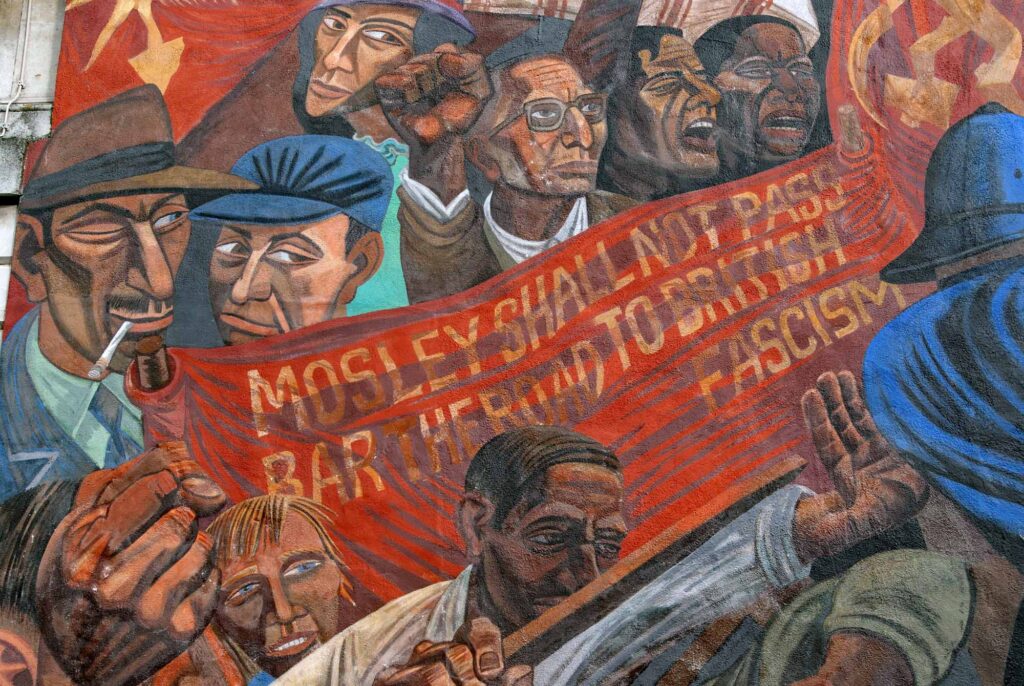
Photo Jim Osley/CC
The 1930s was a period of revolutions and counter-revolutions, of turmoil, war, polarisation and workers’ uprisings. In Spain, major class battles were taking place; between February and July 1936, 133 general strikes were called. The chant ‘No Pasarán’ was used by workers in Spain when they rose against General Franco’s fascist forces and capitalists. Workers internationally were watching these events and getting inspired.
Britain was suffering from huge economic crisis and an acute cost-of-living crisis. There was mass unemployment. The day after the Cable Street events, the famous Jarrow march of unemployed workers set off from the North East. Workers also had to confront fascists who posed a serious threat. They were organised, violent, and actively stirring division within communities, whipping up fear and threatening migrant communities.
The Labour Party, although seen by big sections of the working class as ‘their party’, did not put forward the measurers needed to confront the fascists or a socialist programme to cut across their divisive ideas. George Lansbury, former Labour Party leader and who had led the Poplar rebellion in East London in the 1920s, wrongly advised those who opposed fascism to “keep away from demonstrations”.
Today, the Labour Party is on par with the Tories in stirring divisions and looking for scapegoats amongst the working class. Their continuation of pro-austerity policies has atomised the vital services for working-class and young people. What future is the Labour government offering to ordinary people? Low pay, overwork and a multitude of crises – cost of living, housing, NHS, education etc. Is it any surprise that the social support base for the traditional establishment parties is low? Workers are picking up any stick to express their anger and frustration. There is an outcry for an alternative.
In 1936, just like the Labour Party, most trade union leaders also called on people to stay away and let the police deal with the fascists.
However, the role of the police, then as now, is ultimately to serve the interests of the capitalist state. On the day itself, 6,000 police officers were on duty. They failed to escort the fascists through the streets because they could not get past the hundreds of thousands of protesters. Oswald Mosley, who sought to emulate Hitler by establishing the BUF after being a Tory and Labour MP, was defeated and utterly humiliated. The Metropolitan Police Commissioner even apologised to Mosley.
In 1930s Britain, the Communist Party, resting on the authority of the 1917 Russian Revolution in which the working class had taken power for the first time, had an important base of support among the working class. On Cable Street, its leadership opposed direct action until the eleventh hour and instead called a rally in Trafalgar Square. East London Communist Party organiser Frank LeFitte issued a statement: “If Mosley decides to march, let him. Don’t attempt disorder.” Joe Jacobs, secretary of the Stepney branch from 1933 to 1937 wrote in his autobiography ‘Out of the Ghetto’ about the mistaken approach of the party. A little over a year after the events of Cable Street, he was expelled from the party for raising these issues internally.
In spite of the Communist Party leaders nationally, its local branches played a key role in mobilisation and organisation. Its members in Stepney were leading local activists on the ground. The local branch had more than 1,000 Jewish members. They had also built campaigns against exploitative landlords, organised tenants, and developed broad support within communities through campaigns that affected working-class people. Just like today, housing was a major crisis then.
The activists and rank-and-file members in the Communist Party, Labour Party and in the trade unions understood that fascism posed a threat to the local community, particularly to Jewish people. Opposition from below was growing, and rank-and-file activists, together with wider communities, were determined to stop them from marching. The community was mobilised in an organised way and the anger was harnessed and turned into action – hundreds of thousands of leaflets were distributed, posters were put up. More than 100 public meetings were organised across London to urge people to oppose the fascist march. These lessons from history are crucial. It is the united working class that can defeat the far right, fascism and racist division.
Working-class unity
In 1930s it was the Jewish community that was on the firing line. The fascists attempted to make it a scapegoat, to try to marginalise a section of the working class and to build a base. Ultimately the aim of the fascists is to smash the working-class organisations. Today far-right activists are particularly targeting migrants, refugees and Muslim communities. It is the mass organisations of the working class that can cut across this.
Unity in struggle can be built between workers of all backgrounds through a united programme. It is important to emphasise the common interests of all workers and foster unity in the fight against a common enemy. The fascists, the far right and the capitalist establishment politicians promote divisions in order to maintain the power of the capitalist elite and to protect their system.
Last year, the authorities banned the now far-right UKIP from marching through Whitechapel after mass outrage from local communities. Had the march not been banned, it was clear that there was no way the far right could have marched. It was this fear that forced the authorities to intervene.
Cable Street is not just a history lesson; it remains a powerful reminder that the only way to defeat the far right and physically stop them marching is through the mass mobilisation and organisation of the working class from all backgrounds.
Today, the trade unions are the organisations that bring together workers from all backgrounds across workplaces, neighbourhoods and communities. They are the largest organisations in Britain, representing more than 6.6 million workers.
Earlier this year, at the Together demonstration, hundreds of thousands of working-class and young people marched against racism and the far right. Trade unions played a role in mobilising for that demo, including with sizeable turnouts from the National Education Union, for example. It gave a glimpse of the numbers trade unions could mobilise. And many times more, especially if done by linking the struggle against racism to a struggle for jobs, homes and public services for all.
A march bringing together sections of workers struggling for fully funded services and decent pay would have done far more to cut across support for the right, by offering a genuine means for workers to give an organised expression to their anger – pointing towards the need for a working-class political alternative. Instead, the march was organised with the slogan for ‘Love, Hope and Unity’.
The Socialist Party has consistently argued that the trade union movement must take the lead in the struggle against racism, armed with a socialist programme that defends the lives and livelihoods of all workers.
We also call on the trade unions, where necessary, to organise stewarding and collective defence to protect workers and the anti-racist movement from far-right groups. While these forces remain relatively small, they are growing in confidence and must be challenged through the organised strength of the working class.
Scandalously, in 1936 the leaders of the official labour movement largely vacated the field, leaving the fight against fascism in the hands of local activists, communists, and rank-and-file trade unionists.
Time and again, when racist thugs have targeted marginalised groups, workers and ordinary people have come together to resist them. The leaders of the workers’ movement cannot be allowed to evade their responsibility to lead the fight to defend workers from attacks by the far right and those from the capitalist bosses. It is the organised working class that is the force capable of defeating capitalism and the divisions it creates.
We carry a shortened extract written by Tony Aitman to commemorate the 80th Anniversary of Cable Street. Read in full (‘Cable Street: When workers united and fought the fascist threat at Cable Street’ at socialistparty.org.uk)
In 1936, it has been estimated that of the 350,000 Jews living in England, nearly half lived in the East End.
In the street where I lived, Yiddish was the lingua franca that enabled immigrants from Russia, Germany, Austria, Lithuania and a host of other countries to communicate.
This was the heart of Stepney, where over 60,000 Jews lived in cramped terraced housing, typical “two up, two down”. Our house would later have the luxurious addition of a basement, built to afford shelter during the war.
The lead-up to the events of 4 October was a series of meetings throughout east London, as the fascists attempted to whip up working-class opposition to Jews as the scapegoats for the economic crisis and saying “Jewish interests” were responsible for the looming war.
To consolidate his position, and to intimidate the population, Mosley proposed a march through the East End on 4 October: in full uniform. The fascists were to meet at Royal Mint Street, and, after a military style review of the troops, march in four separate groupings to meetings in east London.
There was an immediate response to this; the Jewish People’s Council launched a petition calling for the march to be banned which gained 100,000 signatures within two days. There was massive opposition to the march. Yet, the anger and readiness to act on behalf of the youth and the rank and file of the movement was not matched by the leadership.
The Communist Party (CP) was at its strongest in the East End – CP member Phil Piratin was elected MP for Mile End in 1945. In the street where I lived as a child, virtually everyone was in the Party. However, the Young Communist League had organised a rally in Trafalgar Square on the same day as the march, in solidarity with the Spanish Republic. East London CP organiser Frank Lefitte put out a statement: “If Mosley decides to march, let him. Don’t attempt disorder”.
The Jewish hierarchy organised a sports day out, trying to get the youth away from the East End: “Jews who, however innocently, become involved in any possible disorders will be actively helping anti-Semitism and Jew baiting… keep away”.
But opposition from below was growing. Joe Jacobs, secretary of Stepney CP, was demanding direct confrontation with the fascists. The Independent Labour Party, the CP rank and file, Jewish groups throughout the area, were demanding direct action.
The largest Jewish settlement in the East End then was in Fairclough (now Henriques) Street. Along with the synagogue, ante-natal clinics and youth clubs that it housed, it was an organising and recruiting point for the Communist Party among the Jewish youth – it was there that my mother met my father and recruited him to the Party. They wanted to meet the fascists face to face in organised opposition.
On the day, the East End erupted. Over 300,000 packed east London’s streets – 50,000 congregated around Gardiner’s Corner, the site of a department store between Aldgate and Whitechapel. It was there that a police horse was pushed through the plate glass window of the store and there that my aunt was kicked in the head by another police horse.
At Cable Street, too, barricades were put up to stop the fascists marching and the police defending them. A shower of rubbish and the contents of chamber pots – few houses had indoor sanitation and these were a common feature of workers’ homes – were thrown on the police, while children threw marbles under the horses’ hooves to send them crashing to the ground.
If the fascists had marched through, there would have been an utter rout of the uniformed thugs of the BUF. To prevent this, the Police Commissioner decided the march could not go ahead and the Blackshirts were forced to retreat in complete humiliation.
A united campaign of Communists and Jews on Commercial Road and Cable Street, the Irish Catholic dockers who threw up the barricades, the youth and the women – my mother, 17 at the time, sneaked out of the house to join the battle – had dealt Mosley a major defeat, destroying any hope he may have had of building a mass fascist party in Britain.