
Tower Hamlets: Affordable social housing not data centres
by Pete Dickenson, Tower Hamlets Socialist Party
A few days after becoming Housing, Communities and Local Government minister in the Burnham government, Angela Rayner posted on social media that: “For too long communities have seen their high streets declining around them… We’re putting powers into the hands of communities to crack down on everyday eyesores that blight town centres.”
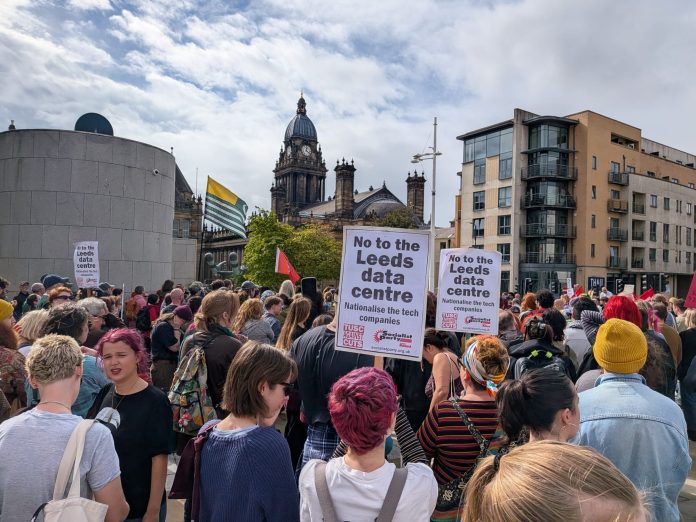
However, a few days before this she had nodded through, against massive local community opposition, a decision by her predecessor, uber-Blairite Steve Reed, to redevelop part of the former Truman’s brewery site in the heart of the Bangladeshi community in Tower Hamlets, East London. As well as a data centre, the scheme will include six social housing units, compared to the Tower Hamlets Council proposal of 345 homes. 30,000 families are currently on the council’s social housing waiting list, and blocking the Truman proposal would have been a statement of intent that the government is serious about building council homes. Rayner’s social media post though was just cynically rubbing salt into the local community’s wound. Yet again, establishment politicians’ actions spoke louder than words.
The controversy over the Truman site has been raging since 2020. The then Labour council, headed by Mayor John Biggs, approved a proposal by Truman Estates, the owners of the site, to build a shopping mall, despite opposition to this headed by the Save Brick Lane campaign. When Biggs was kicked out in 2022, the new mayor, Lutfur Rahman drew up a plan, including 345 social housing homes.
Truman Estates objected to the council proposal and it was withdrawn. In August 2024, the owners submitted three new planning applications, now including a data centre, which went to a public inquiry. Halfway though this, the then minister, Steve Reed, intervened and ordered that the public inquiry inspector should submit the report directly to him to decide, bypassing normal planning procedures. This diktat, not coincidentally, coincided with the decision of the Starmer government to declare data centres ‘critical national infrastructure’. Reed got the sack when Burnham took over, but Angela Rayner nodded his proposal through almost immediately.
There is currently an explosion of data centre construction in London, with 247 built already and 26 more major developments in the pipeline. The huge power requirements of data centres are now threatening to prevent housing developments. In 2022, a London Assembly report revealed that housebuilding was crowded out due to data centre power demand. In West London, a prime site for data centre construction, the electric grid had reached full capacity by 2022 and housing schemes faced a 15-year delay in getting connected.
Pressure to build data centres as close as possible to the centre of London is coming from finance capital. The growth of ‘high frequency trading’ by the speculators means that data transmission speeds are critical, and the closer the data centre is to the trading floor the faster the speeds (high frequency trading is where money is moved around up to a staggering billion times a second to where it gets the highest return). Increasing this speed if only by nanoseconds will reap rich profits, hence the attraction of the Brick Lane data centre, situated only a few hundred metres from London’s financial district. It appears that these increased profits are the ‘benefits to the local community’ claimed in the inspector’s report.
The campaign to stop the Brick Lane development and build social housing instead has mass local support, including from the Socialist Party, and this now needs to be extended. Tower Hamlets Council should contact in particular the Green Party-led boroughs in London, plus any others prepared to fight for council housing, to launch a city-wide campaign to force Andy Burnham to be true to his earlier words and back a mass programme of council home building rather than data centres.
For workers’ democratic control of AI – nationalise!
“We really do earnestly believe AI could kill all humans! I personally think it is greater than 10% within the next decade.” Those are the words of an Anthropic AI researcher responding to one of his colleagues’ public resignation over safety concerns.
Putting aside the likelihood of AI systems developing apocalyptic capabilities, and the fact that super-rich CEOs pile more and more resources into their development to try and end up top of the pile and reap the rewards, meanwhile we don’t have a say in how the technology is developed.
But in the real world, development of this technology is already damaging our health and ability to continue our lives. The massive resources ploughed into building data centres and the power needed to run them all emits more and more tonnes of fossil fuels into the atmosphere. The unfolding climate catastrophe is already seeing an increase in deadly ‘natural’ disasters – just look at the collapse of the glacier and flash flood in Nepal killing over 1,000 people and leaving in its wake a swath of devastation.
We can’t leave this technology, and the decisions over production that belch out polluting fumes, in the hands of a tiny capitalist elite. We need to take their wealth and power and democratically plan production in a way that benefits us all, and doesn’t harm the environment.
Full article at socialistparty.org.uk