
by Paul Kershaw
The summer of 1976 was unusually hot, and conditions in workplaces were often close to unbearable, helping to bring work tensions to a head. The official report on the Grunwick strike makes reference to lack of air conditioning in the ‘dog days’ of August. Many will recognise that in the experience of the heatwave this summer.
On Friday 20 August, one worker at the Grunwick Film Processing Laboratories was sacked for allegedly working too slowly. Three others walked out in protest. Later that day, another employee, Jayaben Desai, was dismissed after preparing to leave work at the end of her shift rather than doing compulsory overtime. She and her son joined the walkout. On Monday 23 August, the six workers began picketing outside the factory, and many more walked out. This began an epic struggle for better pay and for union recognition which attracted support from the workers’ movement nationally and lasted for nearly two years.
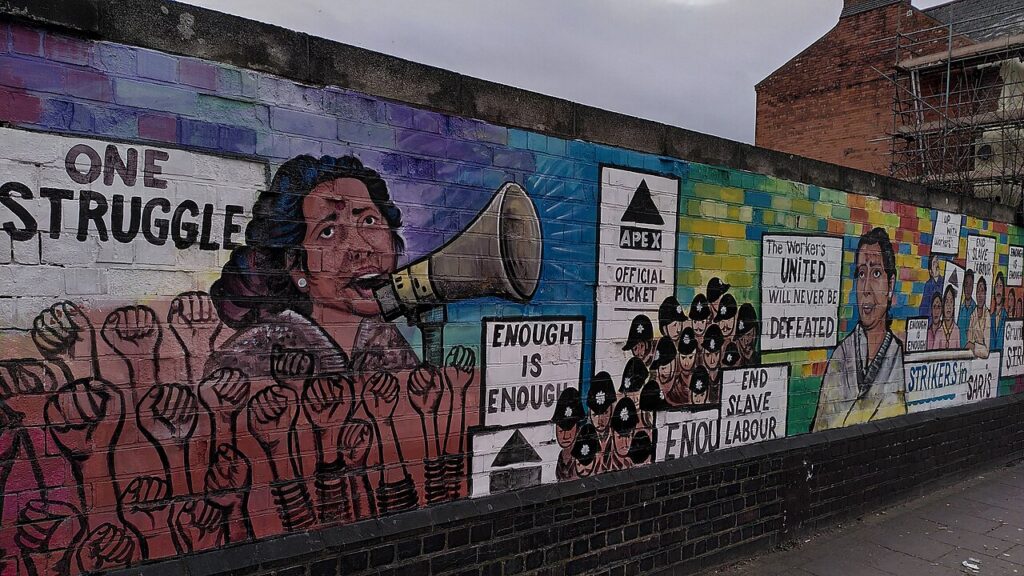
The workforce of the north London photo processing plant was low paid and subject to arbitrary discipline. Many of the workers were Asian women. The bosses had consciously employed recent female migrants because they thought they could be pushed around and exploited more easily. This was a strike by a mainly ethnic minority workforce (80% Asian and 10% Afro-Caribbean) at a time when racist attacks had been on the rise.
‘We are lions, Mr Manager’
Asian women in saris may have conjured up for some a 1970s stereotype of meek behaviour, but the strikers showed a confident determination that got a huge response from the ranks of the trade union movement. That spirit is captured in the words of Jayaben Desai, who became a leader of the strike, addressed the boss: “What you are running here is not a factory, it is a zoo. In a zoo there are many types of animals. Some are monkeys who dance to your tune. Others are lions who can bite your head off. We are those lions, Mr Manager.”
Throughout the 1970s there had been a rising tide of strikes to improve conditions, and a high level of trade union consciousness. Action by miners, car workers and other traditionally well-organised workers inspired others to get organised. The capitalist class saw this a threat that had to be crushed, and Grunwick became a test case. Sir Keith Joseph, who Tory leader Margaret Thatcher called her closest political friend, explained that Grunwick could be “all our tomorrows” if the workers forced their employer to recognise their union with the help of solidarity action and picketing; it was a ‘litmus test’.
Joseph spoke of “red fascism” and other Tory MPs campaigned for the employer, while shady groups such as the ‘National Association for Freedom’ organised legal support for the bosses as well as covert activities to undermine solidarity action. The Tories drew on the experience of Grunwick when drawing up the anti-union legislation they introduced after they won the 1979 general election, and which still hampers workers’ organisation. Labour’s recent extremely limited trade union reforms leave key aspects, such as banning solidarity action, in place.
Solidarity action and Militant
In this pre-digital time, negatives from cameras were posted to photo processors such as Grunwick to be developed into printed pictures, which were returned by post. Local postal workers put their jobs on the line to boycott Grunwick in solidarity with the strikers. The company made a partial retreat and said it would engage with the government conciliation service ACAS, while also making legal threats. The leaders of the postal workers union responded by instructing their members to drop the boycott.
I remember going from workplace to workplace with other Militant (the forerunner of the Socialist Party) activists to discuss the question of wider solidarity action with local shop stewards. Some wanted to discuss how to publicise the issues with their members, others wanted to organise to get clear official support from their unions. Every union rep I spoke to was keen to support the strikers.
The call of a minority of union leaders, such as Arthur Scargill of the Yorkshire miners, for mass pickets got a huge response. Workers from around London, miners from Yorkshire, Kent and Wales, car workers and engineers from around the country and others thronged the small suburban streets of Dollis Hill.
On one occasion, they not only succeeded in stopping the scabs’ bus getting in but also repulsed a cavalry charge by thirty-six mounted police. On one of the biggest pickets, 243 picketers were treated for injuries, including 12 broken bones in a single day.
It is clear that with solidarity action and mass pickets the workers could have won. Willingness to support from fellow workers was demonstrated repeatedly despite the role of their leaders. But union leaders were keen to direct the dispute down legal channels. Roy Grantham, the particularly right-wing leader of the striker’s union, APEX, called for pickets to be scaled down and threatened the strike committee with withdrawal of support if they would not agree.
Strike leader Jayaben Desai explained her view: “I have no faith in the legal position. I only believe in the power of the trade union movement. Nothing happened for forty-four weeks. We played cricket. The mass picket brought the issue to a head, and the mass picket will win it.”
The Labour government set up a commission of inquiry under Lord Scarman and in return the pickets were called off in mid-July 1977. Two months later the Scarman Inquiry recommended reinstatement of the strikers. Grunwick refused to do this, and the leadership of APEX encouraged hopes that the government conciliation service, ACAS, would somehow come up with a solution.
Strikers resisted attempts to wind down the strike, even organising a hunger strike outside the TUC headquarters. Their union’s response was to suspend their strike pay for four weeks.
Lack of leadership
The ruling class was determined to crush this movement of highly exploited workers using all the weapons it had, including the law. The employer was vulnerable to solidarity action, the response to calls for mass pickets was huge, there was a Labour government which had been elected on a claim that it would carry out a fundamental and irreversible transfer of wealth to the working class, and trade unions had never been bigger. But the strike was defeated by the trade union leaders determination to force the struggle into a legal straight jacket.
At one point Desai, who was 4 foot 10 inches tall, was arrested for allegedly threatening the owner’s son, but there was no enforcement action when the employer was instructed to recognise the union. The experience of Grunwick has many lessons for today and a crucial one is that the law is far from neutral between workers and capital.