
On 23 September, a meeting of transport union RMT activists was organised by London Underground Engineering Branch, the largest branch in the RMT with 3,200 members, under the title ‘Your Party – what is the role of RMT?’
The meeting was addressed by two former Labour MPs: Jeremy Corbyn, now an Independent MP, who along with Zarah Sultana has announced the launch of a ‘Your Party’; and Dave Nellist, now chair of the Trade Unionist and Socialist Coalition (TUSC).
The RMT could play a significant role in getting a new working-class based party off the ground. After being expelled from the Labour Party in 2004 for supporting Scottish Socialist Party candidates, the RMT under Bob Crow’s leadership continued to campaign for an anti-austerity working-class political voice. Bob helped to initiate No2EU-Yes to Democracy in 2009 and then TUSC in 2010. The RMT was formally represented on the TUSC steering committee for ten years from 2012. The RMT was also the first union to support Jeremy Corbyn’s leadership of the Labour Party, with the biggest donation to his campaign after Unite, despite not being an affiliated union.
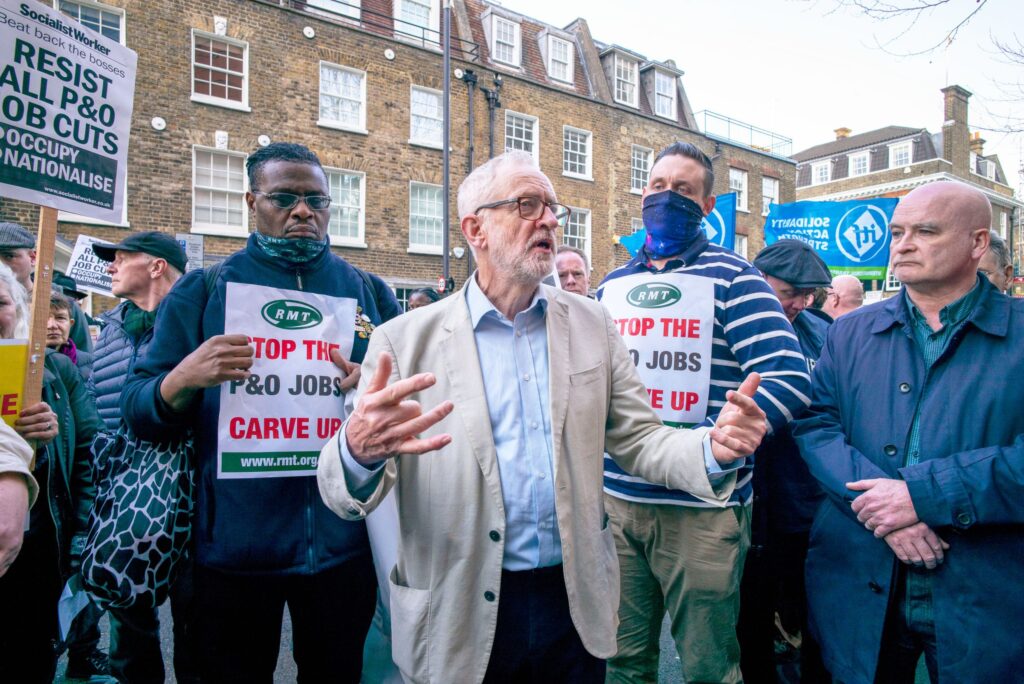
Photo: Paul Mattsson
It was therefore every important that this discussion took place between Dave, Jeremy, and reps and activists in the RMT, including Assistant General Secretary Daren Ireland.
All agreed that a programme of anti-austerity, house-building, reversing cuts in services and the social wage, and opposing the genocide in Gaza is paramount to building a political alternative that can start to undercut support for Reform and the far right.
All those who contributed in the discussion also agreed that the RMT should be able to affiliate to this new organisation, as should other trade unions, to harness the power of organised labour alongside the 800,000 people who have signed up to Your Party.
In his introduction, Dave argued for “a discussion around the idea of a federal beginning to a party.” He said: “I think it’s time that the trade unions – with the reach that they have, with the resources that they have, with the activists that they have in working-class communities – play a central role in discussing how a new party should be formed, how it should be structured and organised, what sort of policies it should have.”
Jeremy confirmed that “the relationship with unions is open for debate and discussion”.
After hearing the discussion, he explained about the experience of having a group of MPs that took the policies of the RMT into parliament: “The RMT group in parliament used to be made up of MPs that were sponsored by the RMT, but they weren’t necessarily particularly in line with RMT policies on their behaviour, their voting records or anything else. John McDonell, myself and others then set up an RMT group, which essentially was ‘friends of the RMT’. The response we got from Bob Crow and others was that a small group of socialist MPs was far more effective than those that were there before… We had a meeting roughly once a month to go through issues they wanted raised.”
He went on to argue that the “relationship between unions and the Labour Party… wasn’t always good. There were times at the Labour Party conference when very undemocratic casting of block votes would alter decisions massively without any authority from the members of unions.”
Therefore, he argued, “any affiliation needs to have some democratic safeguards that go with it. I’m not exactly sure what they are, but I like the idea that you form a branch of Your Party … and then you have an RMT branch affiliated who will be there and a presence at every meeting. Do they then have a block vote from the local branch, or do they come as local members, or do they have a special status with it? I don’t have all the answers to that, but I think it’s absolutely essential that the unions locally be fully involved.
“Maybe others could come in via the Trades Council. There’s a lot of ways of looking at it, but it’s absolutely right that for the party to be successful, it has to have a substantial and significant trade union involvement in it.”
RMT motion
This is the motion that was passed at the Picadilly and District West RMT branch on 17 July, before the 24 July ‘Your Party’ announcement by Jeremy Corbyn and Zarah Sultana, and subsequently agreed at the London Transport Regional Council meeting on 31 July, after the Your Party launch, with 14 branches for and one against.
Please use it as a model to pass in your RMT branch, and adapt if needed:
This branch notes the announcement by Zarah Sultana that she has resigned from Labour to co-lead a new party with Jeremy Corbyn, and from Jeremy Corbyn that “the democratic foundations of a new party will soon take shape”.
We further note the unacceptable delay to real improvements that workers were promised by the Labour government, the Labour mayor’s lack of progress on insourcing within Transport for London, and the ongoing attacks on public services and social welfare.
We call on the NEC to reach out to Jeremy Corbyn and Zarah Sultana to discuss mutual goals, and also to discuss with like-minded unions, such as Unite and others, about the need for trade unions to be at the forefront of the formation of any new workers’ party, and to discuss and be involved in the drafting of programme and policy at a founding conference, which should be based on representative delegates from trade unions, socialist organisations and community groups – as was the case when Labour was founded over a century ago.
This party needs to be anti-cuts, and also needs to have a programme to unite the working class on a socialist programme of nationalisation, to take the wealth from the billionaires and to spend the wealth on house-building, schools, the NHS etc.
Our forebears were involved in founding the Labour Party over a hundred years ago when the Liberals failed to represent our class.
Starmer’s Labour is attacking our class and no longer represents our interests. This has contributed to a section of our class and members turning in desperation to the far-right racist Reform, who like Labour, Tories and Liberals, represent the billionaire class.
We need a voice for the working class and our union must engage with this new formation and report back to members before the run up to the May 2026 elections.